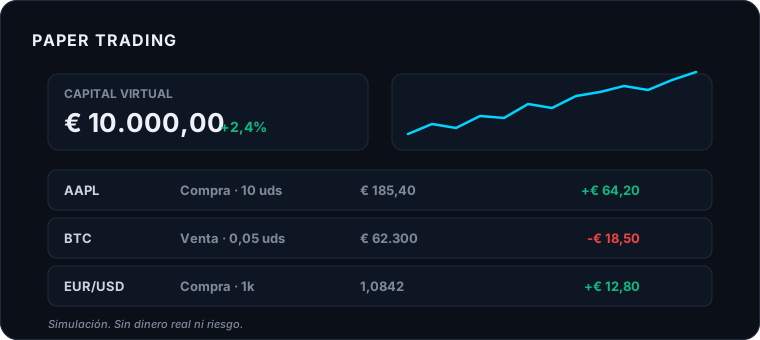
Paper trading is probably the best bridge between studying technical analysis and risking real money. It lets you practise your strategy on real, real-time prices, but using fictitious capital. In this guide you'll see what it is exactly, how it differs from backtesting, how to get the most out of it and what to avoid so the jump to real money doesn't blow up in your face.
What paper trading is
Paper trading literally means trading "on paper": simulating buy and sell orders without real money involved. Today it is done on platforms that mirror market behaviour but use virtual balances. The name comes from the traders who, before the Internet, wrote their entries and exits in a notebook to see how their ideas would have played out.
The idea is simple: you learn to execute, manage and close trades without financial risk, but under (partial) real conditions and emotions.
Paper trading vs backtesting: not the same thing
Many people confuse them, but they are different and complementary:
- Backtesting: you apply a strategy to past data. It is fast, gives you statistics and measures historical behaviour. But it does not train your execution.
- Paper trading: you apply the strategy in real time on current prices and without real money. It is slower, but it trains your discipline, reaction time and tolerance for mistakes.
The logical order is: idea → backtest → paper trading → small real capital → scale up. Skipping paper trading is one of the reasons many "good" simulated strategies collapse once real money goes in.
What paper trading is really for
- Test your strategy in real time, not just on history.
- Learn the platform: where every button is, how stops are entered, how orders are modified. Making mistakes with virtual money is free.
- Build discipline: respect stop-loss, do not double down on losers, exit when planned.
- See your own behaviour: if you break rules in simulation, you will do it more easily with real money.
- Validate rules that backtests do not capture well: opening times, gaps, news.
How to do paper trading properly
1. Treat it like real money
If you decide your virtual account is €10,000, trade as if you had it. No doubling sizes because "it's just a game". If you do that, you are not practising; you are playing a video game.
2. Log every trade
Entry, exit, reason for entry, reason for exit, what you felt, what you would do differently. A trading journal is where the real learning happens, not on the chart.
3. Define a minimum number of trades before evaluating
20 trades is not enough. Ideally 50–100 trades before drawing serious conclusions. A 5-trade winning streak doesn't mean the strategy works.
4. Respect your stops
If your rule said exit at -2%, exit at -2%. If you skip the stop in simulation "because it will bounce", with real money it will be worse.
5. Set a minimum time frame
One month minimum, ideally three, before jumping to real. Markets go through phases (trend, sideways, high volatility) and only by seeing them you find out how your strategy behaves.
What paper trading cannot train
Let's be honest: the real psychology of losing your own money cannot be fully simulated. Stomaching a 15% drawdown on a virtual account is not the same as seeing it on your real account with your savings. That is why, after paper trading, the recommendation is to jump to small real capital, not directly to the full account.
Other limits of paper trading: execution is usually perfect (real markets have slippage), platforms sometimes give "too favourable" fills and the emotional cost of each losing trade is missing.
Typical paper-trading mistakes
- Not taking it seriously and trading impossible sizes.
- Jumping to real too soon after a few winning trades.
- No journal: without records, no real learning.
- Changing strategy every week: no idea survives if you change it before having enough data.
- Staying in paper trading forever: past a point, what you learn no longer pays off. It is time to take the step, small.
Disclaimer: paper trading is an educational tool. Although it removes financial risk, it does not guarantee your strategy will work with real money. Trading involves a high risk of loss. This content is educational and does not constitute financial advice.
Practise without installing anything
SuperRobot AI Pro lets you study indicators and validate entry/exit rules in the cloud before exposing real capital.
Start 7-day trial