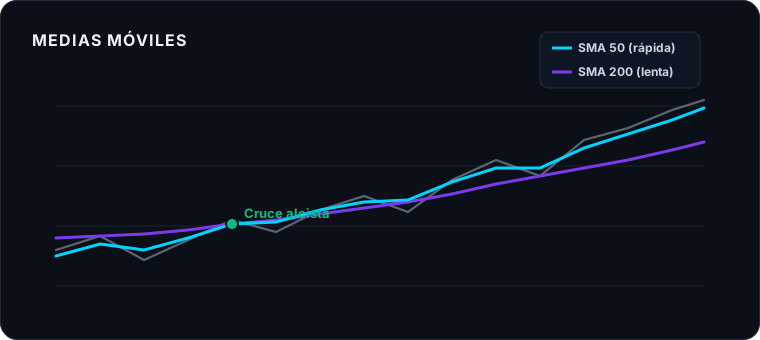
Moving averages are one of the simplest and, at the same time, most useful indicators in technical analysis. They smooth out price noise and help you see in which direction an asset is really moving. In this guide you'll see what they are, the most-used types (SMA and EMA), how to pick a period and how to apply them without falling for the classic mistakes.
What a moving average is
A moving average is simply the average of price over a set number of periods. If you take the mean closing price of the last 20 days and plot it on the chart, you have a 20-period moving average.
Because every day it is recalculated with the most recent data, the line "moves" following price. That is why it is called moving. Its usefulness: it gives you a visual reference of recent "typical" price and helps you separate trend from noise.
SMA vs EMA: which one to use
Simple Moving Average (SMA)
It is the classic arithmetic mean. Every price in the period weighs the same. It is easy to understand and very stable, but it reacts with some lag when the market changes.
Exponential Moving Average (EMA)
It gives more weight to recent prices. It reacts faster to trend changes, which is useful for short-term operations, but it also produces more false signals in sideways markets.
As a general rule: SMA for medium/long-term trend analysis, EMA when you need to react faster on shorter time frames.
Typical periods and what they mean
- SMA 20: very short-term trend (roughly a month on daily).
- SMA 50: intermediate trend.
- SMA 200: the big long-term reference. When price is above the SMA 200 on daily, the market is considered bullish; below it, bearish.
There is no "magic" period. The one that works best depends on the asset and the time frame. The important thing is to be consistent: if you choose 50 and 200, don't switch to 30 and 100 every week.
How to use moving averages step by step
1. Identify the direction of the market
If price is above a long moving average (for example SMA 200) and that average points up, the context is bullish. If it is below and the average is falling, it is bearish. Trading with that direction is usually more profitable than fighting it.
2. Use them as dynamic support and resistance
In clear trends, price tends to "bounce" off the moving average when it gets close. It is not magic: it is a zone where many participants get interested again in the asset.
3. Moving average crosses
When a fast average crosses above a slow one, it is interpreted as bullish (the so-called golden cross); when it crosses below, bearish (death cross). It works best in markets with a clear trend; it fails a lot in sideways markets.
4. Combine with other indicators
Moving averages are better understood alongside a momentum indicator such as the RSI or MACD. The average gives you trend context; momentum, the strength of the move.
Common mistakes with moving averages
- Trading every cross: in sideways markets, crosses pile up and produce continuous false signals.
- Changing the period each time to "fit" the signal. That's overfitting, not analysis.
- Forgetting the context: a bearish signal in an overall bullish market is more likely a pullback than a reversal.
- Confusing smoothing with prediction: the average is retrospective. It does not guess anything; it only describes.
Moving averages and risk management
A useful idea: use a moving average as a trend filter and on top of it define stops and position sizing with another criterion (ATR, supports, fixed percentage). The average tells you where the asset "breathes"; your risk management decides how much you risk.
Disclaimer: trading involves a high risk of loss. Moving averages are a study and description tool; they do not predict the future or guarantee results. This content is educational and does not constitute financial advice.
Practice with moving averages without installing anything
SuperRobot AI Pro includes SMA, EMA and cloud backtesting. Designed to study trends and rules with real data.
Start 7-day trial