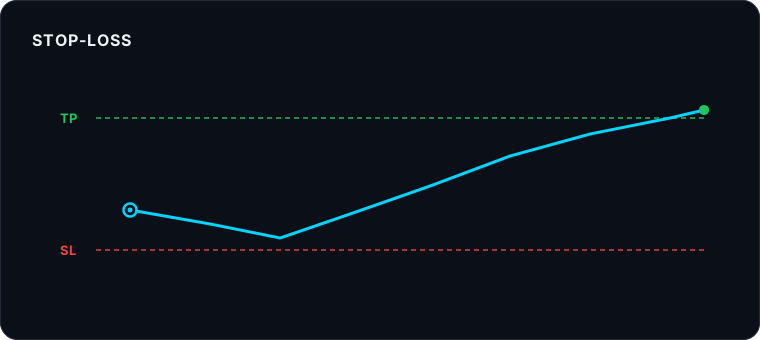
The stop loss is probably the most important tool for surviving in trading, and at the same time the one beginners ignore the most. In this guide you'll see what a stop loss is, why it is essential, what types exist and where to place it so it protects you without being knocked out by noise.
What a stop loss is
A stop loss is an order that automatically closes your trade when price reaches a loss level you decided in advance. In practice, it is the maximum amount you are willing to lose on that trade.
The key idea: the stop loss is defined before you enter, when you think calmly, not in the middle of a fall when fear or hope are already deciding for you.
Why it is essential
- It caps the loss. It turns an undefined risk into a known, bearable amount.
- It removes the emotional decision. Without a stop, beginners tend to "wait for it to recover" — and that is where a small loss becomes a catastrophic one.
- It lets you plan. If you know how much you can lose, you can size the position and work out the reward/risk ratio.
Types of stop loss
Fixed stop (percentage or amount)
You exit if you lose a fixed percentage. It is simple, but ignores how each asset moves.
Technical stop
It is placed at a relevant chart level: below a support, a recent low or a moving average. It has market logic behind it.
Volatility stop (ATR)
It is set at a multiple of the ATR, so the stop adapts to the asset's real volatility instead of an arbitrary number.
Trailing stop (dynamic stop)
It follows price in your favour: if the trade goes well, the stop moves up to lock in part of the gain. It never moves down.
Where to place the stop loss
The mistake is to think only about "how much I want to lose". You have to combine two things:
- Market logic: the stop should be where, if it is hit, your idea is no longer valid (for example, a clear support broken).
- Room for noise: too tight and the normal price move knocks you out early. The ATR helps to give it the right space.
And a golden rule: if the "correct" stop implies a loss larger than you can take, the solution is not to move the stop closer, it is to reduce the position size.
Common mistakes with the stop loss
- Not using one. The worst of all.
- Moving it to avoid losing. Pushing the stop away when price approaches cancels its only function.
- Placing it at obvious levels: just below a round low where everyone else's stop sits.
- Too tight a stop: it knocks you out by noise over and over.
Disclaimer: a stop loss reduces risk but does not eliminate it; in market gaps it can execute at a worse price. Trading carries a high risk of loss. This content is educational and does not constitute financial advice.
Learn to manage risk with method
SuperRobot AI Pro helps you study levels, volatility and indicators in the cloud to structure your exit rules.
Start your 7-day trial