Most beginners obsess over finding the perfect entry. But the traders who survive in the long run do not do it by being right more often — they do it by managing risk well. In this guide you'll see the pillars of risk management in trading, explained simply.
What risk management is
Managing risk means deciding, in advance and with rules, how much you can lose on each trade and across your whole account. It does not eliminate losses — they are part of the game — but it stops a bad streak or a single mistake from wiping you out.
The underlying idea: you can be wrong many times and keep going, as long as each mistake is small and controlled.
The percentage-per-trade rule
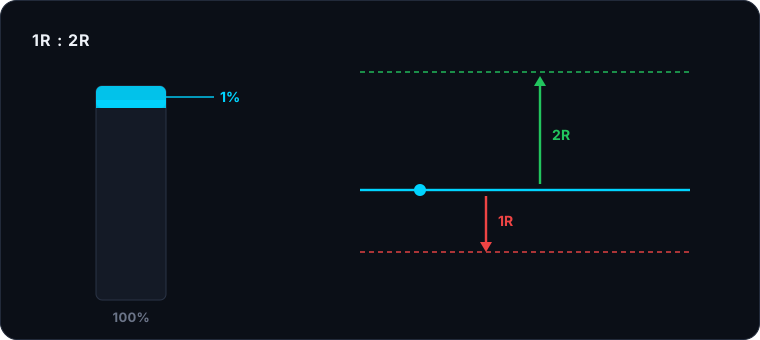
This is the best-known principle and the most useful: do not risk more than a small percentage of your account on a single trade, usually between 1% and 2%.
At 1% per trade, it would take many losses in a row to do serious damage to the account. At 20% per trade, five mistakes leave you out. The difference between lasting and blowing up is not about being right more often — it is here.
Position sizing
The risk percentage and the stop loss together tell you how much to buy. The calculation is straightforward:
- You define how much money you risk (for example, 1% of the account).
- You define the distance to the stop loss.
- The position size is the one that makes you lose exactly that 1% — and no more — if the stop is hit.
So a more distant stop forces a smaller position. The maximum loss is always the same; what changes is the size.
The reward/risk ratio
Before entering, compare what you risk with what you can realistically gain. If you risk 1 to make 1 (a 1:1 ratio), you need to be right more than half the time just to break even. If you look for trades with a 1:2 ratio or better, you can be profitable even while being wrong more than half the time.
Diversification and correlation
Spreading risk across several positions reduces the impact of a single mistake. But beware of correlation: holding five assets that move together (for example, five tech stocks) is not diversifying — it is the same bet five times.
The factor that ruins the most accounts: psychology
The best risk management system is worthless if you skip it when it suits you. The typical mistakes are emotional:
- Moving the stop to avoid taking the loss.
- Doubling the position to "recover" quickly (so-called revenge trading).
- Skipping position sizing because "this time you are sure".
Writing the rules down and testing them with backtesting helps you not to improvise in the heat of the moment.
Disclaimer: risk management reduces the chance of large losses but does not guarantee profits. Trading carries a high risk of loss. This content is educational and does not constitute financial advice.
Structure your risk management
SuperRobot AI Pro helps you study volatility, levels and backtesting in the cloud to define consistent risk rules.
Start your 7-day trial