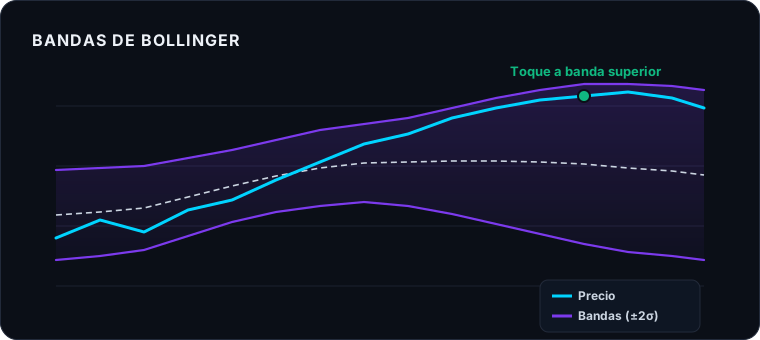
Bollinger Bands are one of the most visual and popular indicators in technical analysis. Designed by John Bollinger in the 80s, they measure volatility and draw a channel that expands and contracts with the market. In this guide you will see what they are, how they are calculated, how to read them and the typical mistakes when using them.
What Bollinger Bands are
Bollinger Bands are three lines drawn over price:
- Central band: a simple moving average, usually of 20 periods.
- Upper band: the central average plus 2 standard deviations.
- Lower band: the central average minus 2 standard deviations.
Statistically, price spends most of the time inside these two bands, because two standard deviations cover roughly 95% of the values in a normal distribution. When price touches or crosses a band, it is in an "extreme" zone relative to its recent volatility.
How they are calculated
- Compute the simple moving average of price (typically 20 periods).
- Compute the standard deviation of price over the same 20 periods.
- Upper band = average + (2 × standard deviation).
- Lower band = average − (2 × standard deviation).
The parameters (20, 2) are the most common, but they can be tuned: 10 periods for short term, 50 for longer term, 1.5 or 2.5 deviations to make the bands narrower or wider.
How to read Bollinger Bands
1. Expansion and contraction: read volatility
When the bands widen, volatility rises. When they narrow (the so-called squeeze), volatility falls: the market is compressing, usually before a big move. A prolonged squeeze often precedes an expansion, although it does not tell you in which direction.
2. Band touches: extremes, not signals
A very common mistake is reading "touches the upper band → sell" or "touches the lower band → buy". In strong trends, price walks along a band for weeks. A touch only means price is in a statistically extreme zone, not that it will reverse.
3. Breaks with expansion
When price breaks a band with a strong rise in volatility (the bands open), it usually indicates continuation, not exhaustion. You need to distinguish between "touching a band" (a statistical touch) and "breaking with force" (a volatility regime change).
4. Mean reversion
In sideways markets, the classic logic does work reasonably: price tends to come back to the central band. But you need to be sure you are in a range, not in a trend, before trading mean reversion. And never without a stop.
Common strategies with Bollinger
Squeeze + breakout
Wait for the bands to tighten to their minimum (low volatility) and trade the breakout in the direction of the close that escapes the band. It works best combined with a trend filter (e.g. SMA 200) and a confirmer such as volume.
Band + RSI
Combining an upper-band touch with an RSI above 70 (or a lower-band touch with an RSI below 30) helps filter out "silly" touches in a trend. The idea: you only care about the extreme when another indicator confirms exhaustion, not just a visual touch.
Bands as dynamic stop
Some traders use the opposite band as a dynamic stop. It is aggressive but keeps you in extended trends.
Typical mistakes with Bollinger Bands
- Buying every lower-band touch and selling every upper-band touch, with no trend filter. In clear trends, this loses money systematically.
- Changing the parameters (20, 2) constantly to make them "fit" what already happened. That is visual overfitting.
- Ignoring context: the bands describe volatility, not direction. You need another criterion for the market bias.
- Trading without a stop: trusting that price "always comes back to the mean" is one of the fastest paths to a big loss.
When not to use Bollinger Bands
In very illiquid markets or when there are gaps or major news, the bands distort quickly and take time to stabilise. Don't use them as the only criterion on illiquid assets or during shock moments (quarterly earnings, central bank decisions, etc.).
Disclaimer: trading involves a high risk of loss. Bollinger Bands are a tool for describing volatility; they do not predict the future or guarantee results. This content is educational and does not constitute financial advice.
Study Bollinger Bands with real data
SuperRobot AI Pro includes Bollinger and cloud backtesting. Built to study technical analysis in a structured way.
Start 7-day trial